Thinking about studying in the UK? Understanding how grades and degrees work will help you pick the right course, set realistic goals, and interpret admission requirements.
The academic system in the UK can be divided into four sub-sections: primary, secondary, further education, and higher education. The following is a detailed overview of the academic system in the UK: Obtaining a basic education is mandatory for all children aged between 5 and 16 years. The students are assessed regularly throughout these stages of education.
The GCSEs (General Certificate of Secondary Education) are an essential part of UK students’ lives. They appear for these exams once they are 16 years of age. As soon as a student has completed their GCSEs, they can opt for further educational studies and then higher educational studies. Or they could complete their schooling and move on to their professional lives.
Academic Grading System in the UK (How Marks & Classifications Work)
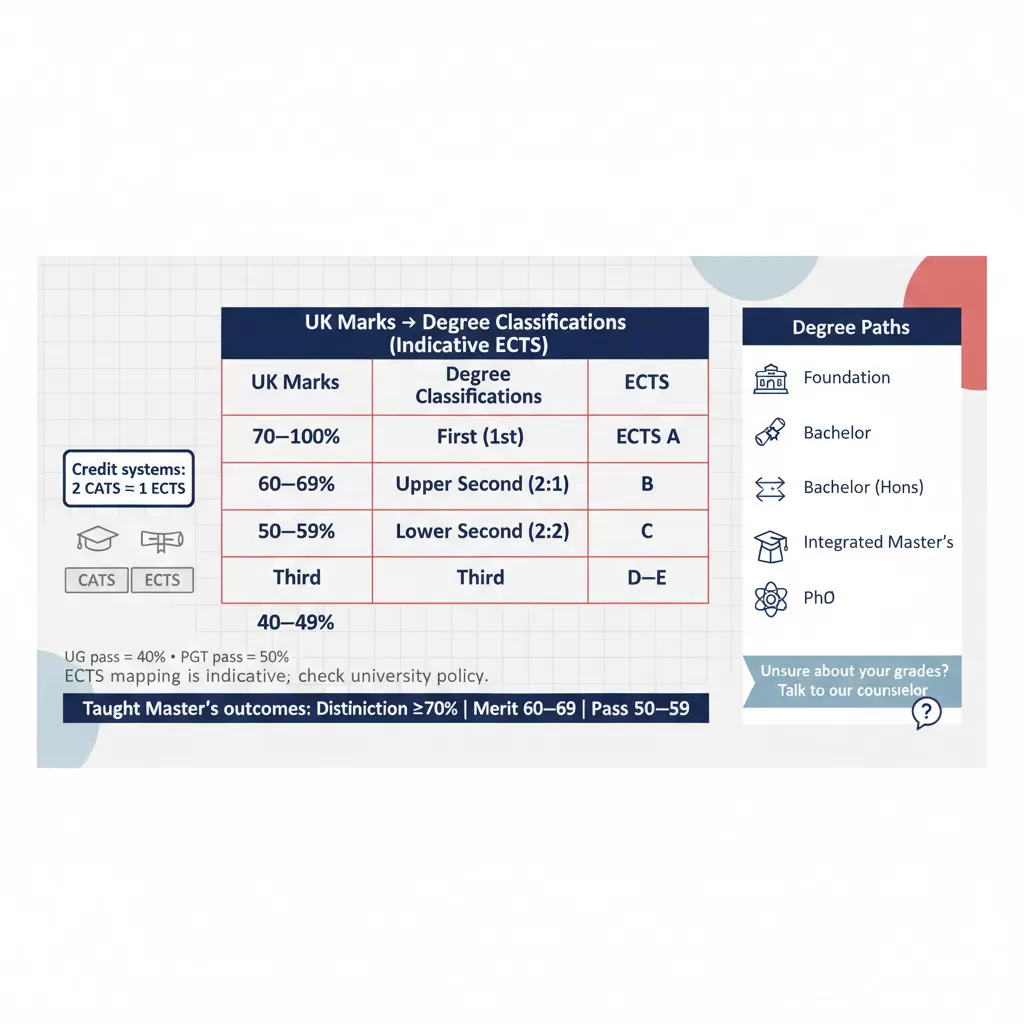
Marking scale (most universities)
0–100 numeric scale for most assessments.
Undergraduate pass mark:40% (some professional courses may set a higher mark).
Postgraduate taught pass mark:50%.
Marks are combined across modules (courses) using each module’s credit weighting to produce your overall classification.
Typical undergraduate degree classifications
First-class (First or 1st):70%+
Upper second-class (2:1):60–69%
Lower second-class (2:2):50–59%
Third-class (Third):40–49%
Fail:<40%
Notes
Some universities use additional rules for borderline cases (e.g., looking at the distribution of higher marks in your final year).
Resits are often capped at the pass mark.
Integrated Master’s (e.g., MEng, MSci) usually follow the same honours bands as above.
Postgraduate taught awards (PGT)
Distinction: usually 70%+ overall (some require ≥70% in the dissertation, too)
Merit:60–69%
Pass:50–59%
Fail:<50%
How credits work (CATS vs ECTS)
UK uses CATS credits: typically 120 CATS per academic year (Undergrad Bachelor = 360 CATS; Taught Master’s = 180 CATS).
Europe commonly uses ECTS: 60 ECTS per year.
Rule of thumb:2 CATS ≈ 1 ECTS (so a 20-CATS UK module ≈ 10 ECTS).
Available Degree Options in the UK
Pre-university & Pathways
Foundation Year / International Foundation Programme: 1 year to bridge into a bachelor’s degree.
HNC/HND (Higher National Cert./Diploma): Vocational, can top-up to a bachelor’s.
Undergraduate
Bachelor’s with Honours (BA, BSc, BEng, LLB, etc.): typically 3 years in England/Wales/Northern Ireland, 4 years in Scotland.
Sandwich/Placement Year: adds an industrial placement or study abroad year.
Integrated Master’s (MEng, MSci, MMath, etc.):4 years (5 with placement); ends with a Master’s-level award but classified like an honours degree.
PGDip / PGCert: shorter taught awards that can count toward a Master’s.
Postgraduate Research
MRes: research-intensive Master’s (often a step toward PhD).
MPhil: substantial research degree; sometimes a route to PhD.
PhD/DPhil:3–4 years (full-time) independent research with thesis and viva.
Professional & Regulated Degrees
Medicine (MBBS/MBChB), Dentistry (BDS), Architecture (Parts 1–3), Teaching (PGCE/QTS), Law (LLM/SQE route), Nursing/Midwifery, etc.
May have additional progression/placement requirements and higher pass thresholds.
ECTS Grades and the UK Grading Scheme
ECTS: what it actually is
ECTS is primarily a credit and grade distribution framework to make results comparable across Europe.
The older A–F “fixed percentage” model (A top 10%, B next 25%, etc.) has largely been replaced by Grade Distribution Tables, where each institution maps local results to ECTS bands based on actual cohorts.
Typical, practical mapping (rule-of-thumb)
While exact conversions are institution-specific, many universities informally read classifications like this:
UK Classification
Usual UK Mark
Approx. ECTS Band
First-class (1st)
70–100
A
Upper Second (2:1)
60–69
B
Lower Second (2:2)
50–59
C
Third-class
40–49
D / E
Fail
<40
FX / F
Important caveats
This is indicative only. Universities may publish their own mapping tables or use distribution data instead of fixed bands.
UK grades are not a 4.0 GPA; any GPA conversion is non-standard and depends on the target institution’s rules.
For postgraduate taught programmes, Distinction/Merit/Pass are usually mapped to A/B/C respectively, but check the receiving institution’s policy.
Degree Classifications Explained
First-class Degree (1st)
70%+ overall.
Indicates consistently excellent work: original analysis, strong methodology, clear structure, and near-publishable presentation in final-year projects.
Upper Second-class Degree (2:1)
60–69% overall.
Very good performance: strong understanding, sound analysis, good argumentation, and presentation. This is a common minimum for many competitive UK Master’s admissions.
Lower Second-class Degree (2:2)
50–59% overall.
Good/satisfactory performance: clear understanding with some gaps or uneven depth. Many Master’s programmes will still consider applicants with relevant experience.
Third-class Degree (Third)
40–49% overall.
Pass level: meets minimum criteria; understanding is present but limited or inconsistent. Some progression routes (e.g., specific PGCert/PGDip) remain open.
Quick FAQs
Is a 70% in the UK the same as an “A+” elsewhere? Not exactly. The UK market uses different standards. 70%+ is excellent and relatively rare in many disciplines.
Do all universities use the same rules? No regulations (e.g., weighting of final-year credits, dissertation rules, borderline uplift) can differ. Always check your target university’s assessment handbook.
How are final degrees calculated? Typically, by credit-weighted averages across years, often with greater weight on the final year (e.g., 30/70 split for Year 2/Year 3 in a 3-year degree). Some use best-credit algorithms (e.g., “best 100 credits + next best 100 credits”).
How Our Education Counsellor Can Help
Thinking about the UK, but not sure how your grades translate or which degree route suits your goals?
Personalised course matching: We align your background and target career with the right university, course, and entry point (Foundation, Year 1, Top-Up, Pre-Master’s, or Master’s).
Grade & document review: We interpret your transcripts against UKclassifications/ECTS, advise on GPA/percentage narratives, and flag any borderline issues early.
Admissions strategy: We build a tiered application plan (ambitious, solid, and safe choices) to maximise offers and scholarships.
Statement & CV polishing: Targeted feedback to meet UK academic expectations and programme-specific criteria.
Visa & arrival support: Guidance on CAS, visa, accommodation, banking, and settling in so you can focus on your studies.
Ready to get started?
Book a free consultation with our counsellor. Bring your transcript (or a clear photo), and we’ll: